
Bookkeeping in fund management in the world of private funds is not just paperwork, but it is the foundation of trust, compliance and performance. Between venture capital and private equity or AIFs, funds fail or pass depending on the quality of their financial records.
In one of the promising funds, Kalpa Prisha Fund Services (KPFS), we have found that funds fail due to poor accounting habits. Late reconciliations, missed entries or inconsistent reporting may disastrously erode the trust of an investor and pose significant compliance risks. Conversely, with the accuracy and transparency of bookkeeping, funds increase at will.
This blog discusses the 5 main advantages of accurate bookkeeping to investment funds, and how best to make sure that your reporting is always correct, dependable and audit-compliant.
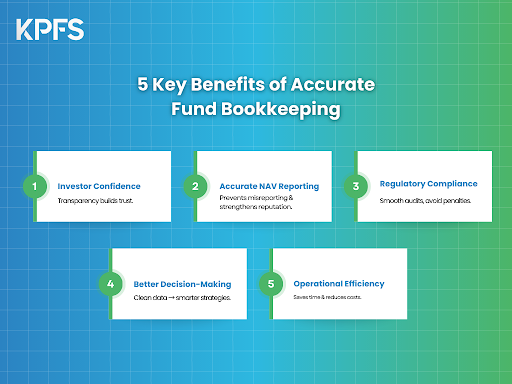
1. Proper Financial Accounting earned investor confidence
That is the only thing that every investor would like to know: that their money is in good hands.
Keeping financial records is not merely a listing of the transactions, but it is also accountability. Investors can easily understand the way in which funds are used, the worthiness of the expenses and where returns are being made.
At KPFS, all the transactions, large or small, are recorded in real time by our systems. This removes confusion and provides the investors with the necessary clarity. When managing funds, transparency is not a choice; it is a competitive advantage.
2. Assuring NAV Accuracy and Reporting.
The figure that all investors monitor is Net Asset Value (NAV). However, inaccuracies in NAV are rather frequent in the case of sloppy bookkeeping.
Even minor inaccuracies can create an impression of the NAV reporting and mislead investors because of incorrect expense allocations and misclassified assets.
To accomplish accuracy of our reporting and NAV, we have systematic reconciliations, automated checks and have clear audit trails. Once the investors are aware that your NAV is correct, then your reputation becomes more robust.
3. Investment Funds Bookkeeping Aids Compliance
Regulators are in charge of fund managers such as SEBI, trustees and auditors. Lack of proper recordkeeping can lead to the delay in compliance, penalties or worst still, loss of credibility.
By adhering to the recordkeeping compliance requirements, you protect the fund against legal or reputational risks. This involves keeping right ledgers, KYC documentation, tax returns and support of audits.
At KPFS, bookkeeping becomes part of compliance processes so that managers will no longer have to deal with last-minute surprises. When records are accurate, then the audits will be smooth and operations will not be interrupted.
4. Clean Data Improves Better Decision-Making
Numbers are not only used by investors, but it assist managers in determining where to grow, sell off or even concentrate.
In situations where there is poor bookkeeping, managers base their decisions on assumptions which are incorrect. With clarity in records, they are able to determine trends, quantify fund performance and compare strategies with certainty.
That is why best practices in fund accounting pay much attention to clean data, reconciled entries and updated ledgers. At KPFS, we offer MIS dashboards which convert raw numbers into insights, which are a real-time pulse of the fund to the managers.
5. Operational Effectiveness and Cost Reduction
Good bookkeeping is not only important in terms of accuracy but also time and money-saving.
Outsourced or automated accounting incurs use of less money on late-minute reconciliation, late filing or penalty payments. Besides, standardised procedures eliminate redundancy and mistakes.
We have assisted funds to simplify the bookkeeping in fund management by automating monotonous processes such as payroll, fund flows monitoring and reporting cycles. The result? Managers do not have to waste much time correcting errors, but use the time to grow.
The External Confidence, Internal Accuracy
The bookkeeping method used at KPFS is aimed at serving two parties:
- Managers who require accurate and real-time information to make intelligent decisions.
- Investors must know that their wealth is being managed in a way that is responsible.
That is why we do not just go to the accounting entries, but we match our systems with fund lifecycles, from fundraising to harvesting.
For a detailed view of how KPFS can support your bookkeeping and accounting needs, visit our services page
How to Strengthen Your Fund’s Bookkeeping
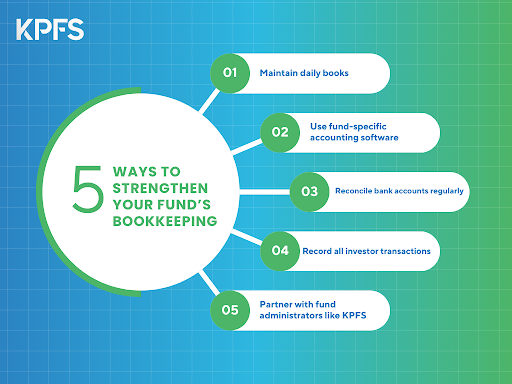
The following are some of the useful measures which managers can adopt:
- Maintain books of account on a daily basis and not quarterly.
- Employ PE, VC or AIFs-specific fund accounting software.
- Balance the bank accounts on a regular basis.
- Record all transactions made by investors.
- Collaborate with fund administrators such as KPFS to have the complete range of support.
Fund Management Bookkeeping is the Prerequisite
It is a simple truth that funds cannot scale without robust bookkeeping in fund management. Compliance, NAV reliability, investor trust, and smarter decisions are guaranteed by accurate records.
We also consider bookkeeping as a strategic tool rather than an administrative one at KPFS. And with us, you always strike a chord with your figures.
FAQs
- Why is bookkeeping in fund management so important?
It prevents non-compliance, precise NAV reporting, investor confidence, and unhindered audits throughout the fund life cycle.
- What are the best practices in fund accounting?
Best practices include regular reconciliations, automated checks, transparent ledgers, and reporting.
- What role does proper recordkeeping of money play for investors?
It creates confidence through the demonstration of the precise location of their capital as well as the effectiveness of such investment, thus removing doubts.
- So what is the purpose of bookkeeping in recordkeeping compliance?
It makes sure that regulatory filings, SEBI submissions and audit processes are supported by sound and current records.
- Will KPFS be able to do the bookkeeping of investment funds?
Yes, KPFS offers PE, VC, and AIF funds accounting, reporting and compliance services.