

Fund Structuring Mistakes That Hurt Returns: 5 Critical Errors
The construction of a closed fund is not only the process of attracting capital, but it is also about constructing it on the very first day.
At Kalpa Prisha Fund Services (KPFS), we have witnessed some great fund ideas fall because of the most basic and most expensive errors made during the formation.
These fund structuring mistakes aren’t just technical errors; they impact compliance, investor trust, and long-term performance. These pitfalls are avoided by those who establish an Alternative Investment Fund (AIF), a private equity vehicle, or a venture capital fund.
So, we will discuss five of the most widespread mistakes fund managers make in structuring their investments and how you can prevent them.
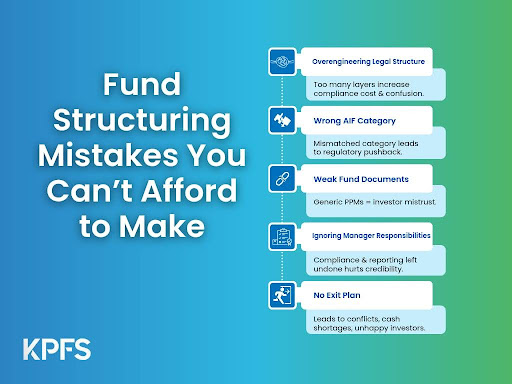
1. Overengineering the Legal Structure of Funds
In an effort to look sophisticated, many new fund managers complicate the legal structure of funds unnecessarily. They consist of various organizations, offshore arrangements or combinations, and they do not know the cost in terms of tax or compliance.
This can create a regulatory mismatch in India, particularly when you are registering as an AIF with SEBI.
Our services at KPFS mentor a client in the direction of to lean goal-oriented structure that undergoes scrutiny and which performs well in the long run onshore or offshore. Keeping it simple does not mean it is weak; it is a strength in the operation.
2. Lack of conformity with AIF Structure Rules
The Indian AIF structure is elaborate and loose it depending on how well you know it. Most managers will select the option that does not match the investment approach.
An example of this would be a situation where a Category II AIF is used as an alternative to Category I, whereby an early-stage venture would have received good incentives.
These AIF structure issues can lead to regulatory pushback, investor confusion, or even fund delays.
Our Office makes sure that your fund is of the right type, sector orientation, and underlines investor rights, all of which are echoed in the Private Placement Memorandum (PPM).
3. Inadequate Fund Documents
One of the more repeated mistakes with new funds is inconsistent or inconsistent reporting. This may be hazy with the PPM. Contracts between investors can be against SEBI rules. Waterfall models may have clauses that do not represent the economic reality of funds.
These are not minor bumps in the legal system; these are red flags to investors.
We do not use templates at KPFS. We draft fund documents that reflect your strategy, remain compliant and make it simple to onboard. Each line is important: whether it is the calculation of NAV and IRR or the rights of the investors.
4. Doubting Fund Manager Responsibilities
As well as being a strategist, fund managers are custodians of compliance. One of the biggest fund manager errors is overlooking day-to-day obligations: SEBI filings, tax compliance, investor reporting, audit support, etc.
We offer end-to-end support services at KPFS, like fund flow management, payroll processing and real-time MIS and fund audit arrangements.
We aim at liberating managers of operational flotsam to concentrate on the things to matter: investments.
5. No Exit Planning during Set up
An exit plan cannot be missing in a private fund. However, lots of funds pour into deployment without understanding how they will redeploy capital or on what terms.
This contributes to conflicts, cash shortage, and discontentment among investors in the future.
Our approach to fund setup in India includes exit planning as part of fund design, not an afterthought.
It can be based on time, performance, or market-dependent, but we will assist managers in laying down defined exit measures within the lifecycle of the fund.

The Real Cost of Fund Structuring Mistakes
Fund structuring is not a checkbox; it is your fund skeleton. When done correctly, it will attract the correct investors, streamline compliance, and make operations sail through the lifecycle.
When it is done poorly, it causes friction all along the way, including during onboarding and exits.
At Kalpa Prisha Fund Services, we have assisted many funds in the VC, PE, and AIF ecosystem to grow dynamically by constructing structures that are in real time and throughout the fund lifecycle: fundraising, investing, and harvesting.
Find out how we prevent such mistakes by managers through our fund administration services.
How to Avoid Fund Structuring Mistakes
Here’s how to build a fund that works from day one:
- Choose the right AIF category based on your investment thesis and target sector.
- Keep your legal structure lean, avoiding complex layers unless absolutely necessary.
- Draft fund documents with precision—don’t rely on generic templates.
- Use expert fund administrators like KPFS to handle accounting, compliance, and reporting.
- Plan your exits early, aligning them with your PPM and investor expectations.
Conclusion: Fix These Fund Structuring Mistakes Early
The most dangerous fund structuring mistakes don’t show up immediately; they surface when it’s too late to fix them. This is why the presence of an experienced fund services partner is important.
At KPFS, we have aided funds to prevent fatal mistakes and remain nimble in terms of regulatory changes, market flux, and investor demands.
Whether you’re setting up a private fund, managing a complex AIF structure, or scaling a PE or VC vehicle, the right structure saves you time, protects capital, and builds long-term credibility.
FAQs
- What are the most common fund structuring mistakes in India?
Selecting an inappropriate AIF category, making the legal structure overly complex, and referring to generic documents of funds are considered to be the most common errors.
- How can Kalpa Prisha help with fund setup in India?
KPFS provides full-spectrum fund administration, including structuring and documentation, to compliance, reporting and fund audit support.
- Why is AIF structure alignment called?
Improperly aligned AIF structures result in delays in compliance, disconcerting investors, and limitations of strategy implementation.
- Which legal structure should a given private fund have?
Trusts or LLPs in India are common; however, they are not all suited to the fund’s purpose, investor type, and tax reasons.
- How do I fix fund structuring mistakes after launch?
Certain mistakes may be fixed after launching by making adjustments, but it is always advisable to have the structure right before the fundraising process starts.